
Calcula el precio del transporte gratis
1 lote para entregar
-
 Lot n° 1042
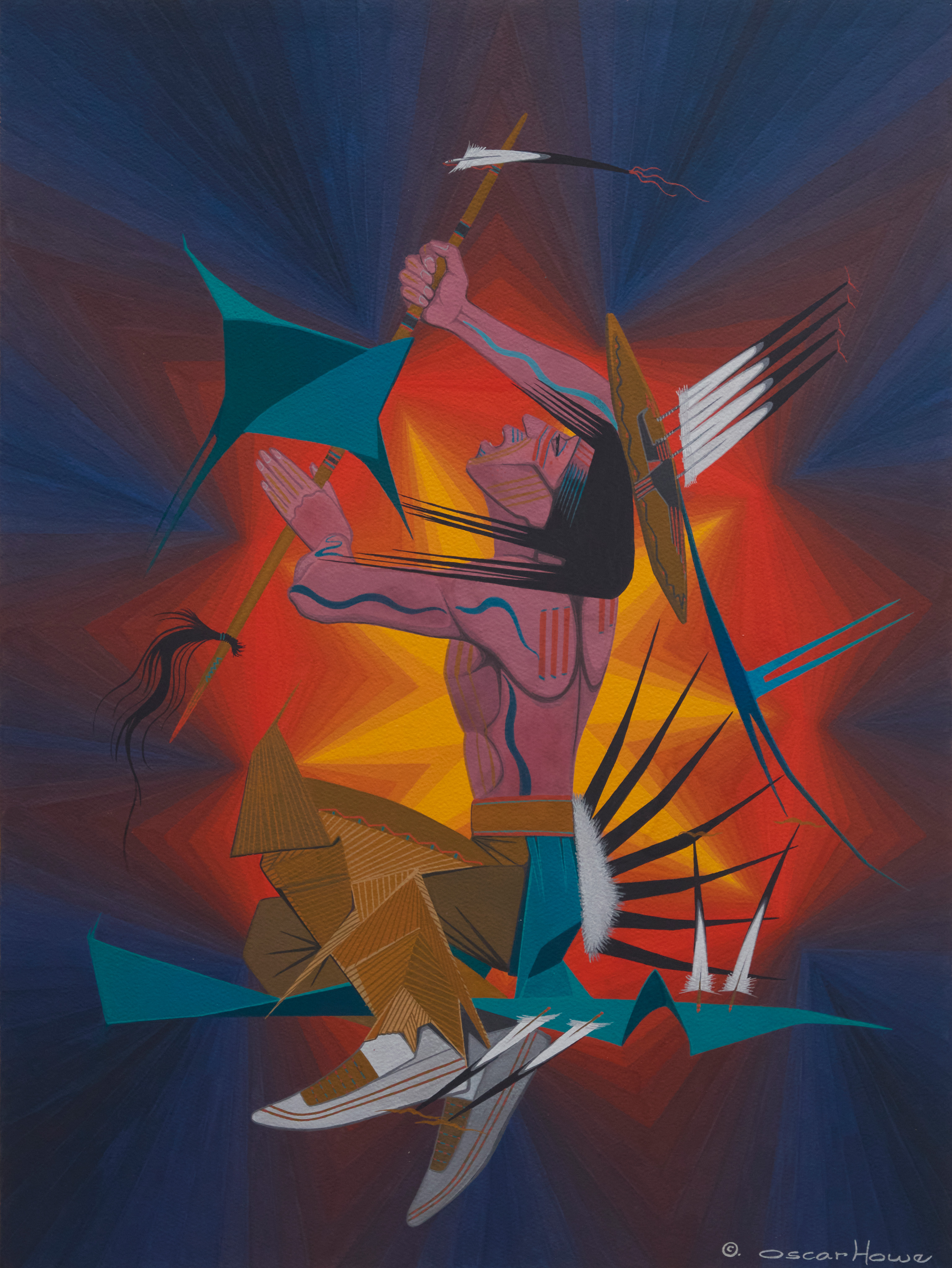
Oscar Howe (1915-1983, Yanktonai Dakota) "War Dancer," 1961 Casein on paper Signed lower right: © Oscar Howe; titled on a label once affixed to the verso of what is presumably the original matboard support (now stored within a protective sleeve on the frame's backing board); this same early artist's label includes "No. 322" below the title Image: 24" H x 18" W; Sheet: 25.5" H x 19.5" W Provenance: The artist Private collection, acquired from the above, November 6, 1961 Exhibited: Omaha, NE, Joslyn Art Museum, "From Private Collections," 1962 Other Notes: The work is listed on the University of South Dakota's Oscar Howe database. In 1958, the Yanktonai Dakota artist Oscar Howe submitted his painting "Umine Wacipi" ("War and Peace Dance") to the Annual Indian Art competition at the Philbrook Art Center. Bold, abstract, and highly experimental, the work departed drastically from the stylistic conventions that had come to define "traditional Indian" painting within the exhibition. Rather than adhering to the flat colors and illustrative compositions associated with the "Studio Style," in which he trained during his early years at the Santa Fe Indian School, Howe employed fractured forms and dynamic movement to create a strikingly modern visual language rooted in Dakota cultural expression. The jurors rejected the painting, claiming it did not conform to their guidelines. In response, Howe wrote a letter to the museum's curator of Native American art, Jeanne Snodgrass, defending both his artistic vision and the broader creative autonomy of Indigenous artists. As Howe asserted, "There is much more to Indian Art than pretty, stylized pictures… Are we to be held back forever with one phase of Indian painting, with no right for individualism, dictated to as the Indian always has been, put on reservations, and treated like a child, and only the White Man knows what is best for him? Now, even in Art" (Dockstader et al., 1982, p. 19). His words not only articulated a powerful challenge to the restrictive expectations placed upon Native artists, but also addressed the political and governmental treatment of Native people more broadly, marking a pivotal moment in the emergence of a modern, self-determined vision of Indigenous art. Born on May 13, 1915, on a reservation in South Dakota, Oscar Howe showed an early affinity for art. Often discouraged by his parents, he nonetheless grew closer to art, especially after a severe skin condition forced him indoors for extended periods. Howe later attended the Pierre Indian School, operated by the Bureau of Indian Affairs, where he endured harsh treatment, and his health challenges only intensified. Returning to the reservation to recover physically and mentally, he spent many hours with his grandmother, Shell Face, who taught him tribal symbols, designs, cultural traditions, and stories of their ancestors. These lessons became deeply ingrained in Howe, providing a wellspring of inspiration that he would draw upon throughout his life, and which profoundly shaped his artistic sensibility. Howe later received formal training at the Santa Fe Indian School under Dorothy Dunn, gaining technical foundations while encountering the rigid "Studio Style," characterized by flat, stylized depictions of ceremonial and historical subjects. Yet this style proved too limiting for his imaginative ambition. Even as a student, Howe absorbed modernist currents circulating in the broader American art world, integrating principles of abstraction and expressive linework with motifs drawn from Dakota culture. This synthesis of tradition and innovation would define his artistic trajectory and set him apart from his contemporaries. He found himself at the intersection of two worlds: the presentation of traditional cultural forms and inspiration from modernist and Romanticist currents, reflecting the social and political transformations of the era. Howe created casein paintings from 1955 to 1978, and "War Dancer," circa 1960, represents an early yet fully mature example of his distinct style, characterized by angular, faceted compositions, rhythmic movement, and layered planes of color. Rather than simply illustrating stories, Howe translated the spiritual and ceremonial life of the Sioux people into a dynamic visual vocabulary, where forms interlock and vibrate across the surface. A central figure dominates the composition, captured in mid-motion, while angular planes and overlapping geometric forms radiate outward, creating a palpable sense of energy and rhythm. Bold, contrasting colors, deep blues and reds juxtaposed with bright yellows and turquoises, frame the figure and emphasize both motion and ceremonial significance. This integration of geometric abstraction and cultural symbolism reflects Howe's conviction that Indigenous art could be simultaneously modern and deeply rooted in heritage, a philosophy that continues to influence Native artists today. Throughout his career, Howe's contributions were widely recognized. He taught at the University of South Dakota, shaping generations of artists, while relentlessly championing the modernist innovation that would come to define his legacy. Today, Oscar Howe's work resonates with a powerful testament to artistic independence and cultural pride. These paintings do more than depict scenes; they summon the spirit, rhythm, and strength of Dakota heritage, offering a window into a vision that is at once intensely personal, profoundly cultural, and boldly contemporary. "War Dancer," endures not only as a historical milestone but as an electrifying visual experience. Through these works, Howe's voice remains vibrant, asserting the enduring significance of Native American art and the transformative power of creativity untethered by convention. Overall good appearance. The colors vibrant and the delicate casein surface without any visible scratches or scuff marks, even when viewed in raking light. The sheet with unpainted margins beyond the image that reveal some of the artist's precise, underlying, original guidelines. The sheet is carefully taped along the outer margin edges to the (presumably original) matboard support with brown paper tape. Framed under glass: 31.5" H x 25.5" W x 1.5" D
Lot n° 1042
Oscar Howe (1915-1983, Yanktonai Dakota) "War Dancer," 1961 Casein on paper Signed lower right: © Oscar Howe; titled on a label once affixed to the verso of what is presumably the original matboard support (now stored within a protective sleeve on the frame's backing board); this same early artist's label includes "No. 322" below the title Image: 24" H x 18" W; Sheet: 25.5" H x 19.5" W Provenance: The artist Private collection, acquired from the above, November 6, 1961 Exhibited: Omaha, NE, Joslyn Art Museum, "From Private Collections," 1962 Other Notes: The work is listed on the University of South Dakota's Oscar Howe database. In 1958, the Yanktonai Dakota artist Oscar Howe submitted his painting "Umine Wacipi" ("War and Peace Dance") to the Annual Indian Art competition at the Philbrook Art Center. Bold, abstract, and highly experimental, the work departed drastically from the stylistic conventions that had come to define "traditional Indian" painting within the exhibition. Rather than adhering to the flat colors and illustrative compositions associated with the "Studio Style," in which he trained during his early years at the Santa Fe Indian School, Howe employed fractured forms and dynamic movement to create a strikingly modern visual language rooted in Dakota cultural expression. The jurors rejected the painting, claiming it did not conform to their guidelines. In response, Howe wrote a letter to the museum's curator of Native American art, Jeanne Snodgrass, defending both his artistic vision and the broader creative autonomy of Indigenous artists. As Howe asserted, "There is much more to Indian Art than pretty, stylized pictures… Are we to be held back forever with one phase of Indian painting, with no right for individualism, dictated to as the Indian always has been, put on reservations, and treated like a child, and only the White Man knows what is best for him? Now, even in Art" (Dockstader et al., 1982, p. 19). His words not only articulated a powerful challenge to the restrictive expectations placed upon Native artists, but also addressed the political and governmental treatment of Native people more broadly, marking a pivotal moment in the emergence of a modern, self-determined vision of Indigenous art. Born on May 13, 1915, on a reservation in South Dakota, Oscar Howe showed an early affinity for art. Often discouraged by his parents, he nonetheless grew closer to art, especially after a severe skin condition forced him indoors for extended periods. Howe later attended the Pierre Indian School, operated by the Bureau of Indian Affairs, where he endured harsh treatment, and his health challenges only intensified. Returning to the reservation to recover physically and mentally, he spent many hours with his grandmother, Shell Face, who taught him tribal symbols, designs, cultural traditions, and stories of their ancestors. These lessons became deeply ingrained in Howe, providing a wellspring of inspiration that he would draw upon throughout his life, and which profoundly shaped his artistic sensibility. Howe later received formal training at the Santa Fe Indian School under Dorothy Dunn, gaining technical foundations while encountering the rigid "Studio Style," characterized by flat, stylized depictions of ceremonial and historical subjects. Yet this style proved too limiting for his imaginative ambition. Even as a student, Howe absorbed modernist currents circulating in the broader American art world, integrating principles of abstraction and expressive linework with motifs drawn from Dakota culture. This synthesis of tradition and innovation would define his artistic trajectory and set him apart from his contemporaries. He found himself at the intersection of two worlds: the presentation of traditional cultural forms and inspiration from modernist and Romanticist currents, reflecting the social and political transformations of the era. Howe created casein paintings from 1955 to 1978, and "War Dancer," circa 1960, represents an early yet fully mature example of his distinct style, characterized by angular, faceted compositions, rhythmic movement, and layered planes of color. Rather than simply illustrating stories, Howe translated the spiritual and ceremonial life of the Sioux people into a dynamic visual vocabulary, where forms interlock and vibrate across the surface. A central figure dominates the composition, captured in mid-motion, while angular planes and overlapping geometric forms radiate outward, creating a palpable sense of energy and rhythm. Bold, contrasting colors, deep blues and reds juxtaposed with bright yellows and turquoises, frame the figure and emphasize both motion and ceremonial significance. This integration of geometric abstraction and cultural symbolism reflects Howe's conviction that Indigenous art could be simultaneously modern and deeply rooted in heritage, a philosophy that continues to influence Native artists today. Throughout his career, Howe's contributions were widely recognized. He taught at the University of South Dakota, shaping generations of artists, while relentlessly championing the modernist innovation that would come to define his legacy. Today, Oscar Howe's work resonates with a powerful testament to artistic independence and cultural pride. These paintings do more than depict scenes; they summon the spirit, rhythm, and strength of Dakota heritage, offering a window into a vision that is at once intensely personal, profoundly cultural, and boldly contemporary. "War Dancer," endures not only as a historical milestone but as an electrifying visual experience. Through these works, Howe's voice remains vibrant, asserting the enduring significance of Native American art and the transformative power of creativity untethered by convention. Overall good appearance. The colors vibrant and the delicate casein surface without any visible scratches or scuff marks, even when viewed in raking light. The sheet with unpainted margins beyond the image that reveal some of the artist's precise, underlying, original guidelines. The sheet is carefully taped along the outer margin edges to the (presumably original) matboard support with brown paper tape. Framed under glass: 31.5" H x 25.5" W x 1.5" D
Nos preocupamos por la privacidad de tus datos. Lee nuestra Política de privacidad.