
Preventivo gratuito del prezzo del trasporto
1 lotto da consegnare
-
 Lot n° 85
Japan, early Iitsu period, circa 1820 - 1834
79 x 33,5 cm / 168 x 46 cm
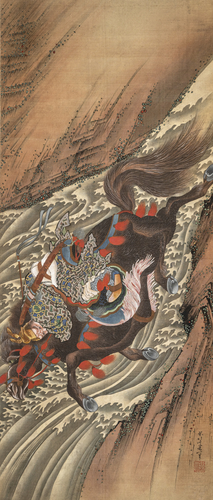
Ink and colours on silk, mounted as a hanging scroll. Depiction of Ryubi sitting on the back of his horse, crossing a river with wild currents between a rocky gorge. Signature: zen Hokusai Iitsu hitsu with seal Katsushika. The painting shows the Chinese warrior Ryubi (Liu Bei) escaping an assassination attempt during a festival in Xiangyang and riding his horse down a cliff and across a stream while looking back to see if anyone is following him. In Hokusai's manga, the character is documented as Ryu Gentoku. The work is an almost literal realisation of the original manga motif. Signature: zen Hokusai Iitsu hitsu with seal Katsushika.With original wood box signed by Hokusai, according to Dr. Jonathan Hutchinson and Matthi Forrer.
Provenance
Collection S.T.P. (label on the tomobako, the original wooden storage box, No. 39.)
Collection of Dr. Jonathan Hutchinson (1859 - 1933). Dr. Jonathan Hutchinson, F.R.C.S., was a distinguished British surgeon and collector who played an important role in the study of Japanese art through his service as a Council Member and Vice-President of the Japan Society, London.
American private collection, auctioned Doyles N.Y., April 4, 2006, lot 3108
Dutch private collection
Exhibition
London: October-November 1915: Exhibition of Japanese Arts and Crafts for the Benefit of the British Red Cross, published in the exhibition catalogue, p. 18, no. 43 with a written reference Dr. J. Hutchinson
References: Katsushika Hokusai (1760-1849), Ryūbi Crossing the Tan River, from Hokusai Manga, vol. 6, 1817. The composition served as the model for the present hanging scroll ( Fig. 1) - Katsushika Hokusai (1760-1849), The Three Generals of the Romance of the Three Kingdoms, surimono, 1827. The figure of Ryūbi (right) provides a useful comparison for the treatment of the face and physiognomy in the present painting. (Fig.2) - Attributed to Katsushika Hokusai (1760-1849), Ryūbi Crossing the Tan River, painted wooden panel, dated Bunsei 1 (1818), Kitamuki Kannon Hall, Jōrakuji Temple. Depicting the same episode from the Romance of the Three Kingdoms, the work offers an instructive comparison in its treatment of horse, rider, and rushing water (Fig 3)
Literature
Published by Matthi Forrer in 'Elegant Gathering in a Scholar's Garden - Studies in East Asian Art in Honour of Jeong-hee Lee-Kalisch, VDG, Weimar, 2015, pp. 186-190, under the title: "Both Ryubi and Hokusai making a jump in a newly discovered Hokusai painting" .
In his essay, Professor Matthi Forrer places the present painting within the broader context of Katsushika Hokusai's artistic development and his continuing engagement with motifs from the Hokusai Manga. The subject depicts Liu Bei (Japanese: Ryūbi), the celebrated hero of the Chinese historical novel Romance of the Three Kingdoms. Pursued by enemies after an attempted assassination, he reaches the banks of the Tan River, where his horse ultimately makes a miraculous leap across the stream, allowing him to escape. Hokusai had already represented this episode in the sixth volume of the Hokusai Manga, published in 1817. Forrer notes that the Hokusai Manga occupied a central place in Hokusai's career. First issued in 1814, the publication originated in sketches produced during the artist's stay in Nagoya in 1812 and eventually expanded into a multi-volume compendium of figures, landscapes, animals, historical subjects and scenes from everyday life. Beyond serving as a drawing manual, the Manga became a reservoir of motifs and compositional ideas that Hokusai repeatedly revisited throughout his career. Numerous themes later developed in his prints and paintings first appeared in sketch form within its pages.The present painting demonstrates this process particularly clearly. While remaining closely faithful to the original Manga illustration, Hokusai transformed the horizontal double-page composition into a vertical hanging scroll. To accommodate the new format, the horse and rider were enlarged considerably and occupy more than half of the pictorial space. As Forrer observes, this adaptation changes the visual emphasis of the scene. Whereas the printed design highlights the width of the river and the daring leap itself, the painting directs greater attention to the steep descent of the landscape, making the episode appear less as a leap across water than as a plunge down a precipice. The work bears the signature zen Hokusai Iitsu hitsu ("painted by Iitsu, formerly Hokusai"), placing it within the period between approximately 1820 and 1834. This dating is significant, as comparatively few paintings from Hokusai's Iitsu years are known. The period was marked by considerable artistic activity, including the production of refined surimono and, later, the designs for which Hokusai would become internationally renowned, among them the Thirty-Six Views of Mount Fuji. It was also a time of personal hardship, following the death of his wife in 1828 and financial difficulties caused in part by debts accumulated by his grandson. Forrer draws particular attention to the extraordinary execution of the horse. Its coat is rendered through numerous carefully modulated shades of brown, reddish-brown, black and grey, creating a vivid sense of texture and physical presence. The painstaking depiction of the animal's hair suggests many hours of concentrated work. According to Forrer, this level of detail surpasses that found in many known works of the early Iitsu period and corresponds more closely to Hokusai's painting style of the 1840s, despite the fact that the present work predates 1834. The painting is therefore of particular interest in relation to Hokusai's later approach to colour and painting technique. Forrer notes that the careful modelling of the horse anticipates principles described in Hokusai's 1848 painting manual, the Illustrated Treatise on the Use of Colors, in which the artist discussed the manipulation of pigments and tonal gradations to achieve convincing representations of animals and natural forms. As a reworking of a composition first conceived for the Hokusai Manga, the present painting illustrates Hokusai's continued practice of transforming earlier designs into independent works. At the same time, it provides valuable insight into his activity as a painter during the comparatively understudied Iitsu period and demonstrates a level of technical refinement that anticipates aspects of his later painted oeuvre.
Lot n° 85
Japan, early Iitsu period, circa 1820 - 1834
79 x 33,5 cm / 168 x 46 cm
Ink and colours on silk, mounted as a hanging scroll. Depiction of Ryubi sitting on the back of his horse, crossing a river with wild currents between a rocky gorge. Signature: zen Hokusai Iitsu hitsu with seal Katsushika. The painting shows the Chinese warrior Ryubi (Liu Bei) escaping an assassination attempt during a festival in Xiangyang and riding his horse down a cliff and across a stream while looking back to see if anyone is following him. In Hokusai's manga, the character is documented as Ryu Gentoku. The work is an almost literal realisation of the original manga motif. Signature: zen Hokusai Iitsu hitsu with seal Katsushika.With original wood box signed by Hokusai, according to Dr. Jonathan Hutchinson and Matthi Forrer.
Provenance
Collection S.T.P. (label on the tomobako, the original wooden storage box, No. 39.)
Collection of Dr. Jonathan Hutchinson (1859 - 1933). Dr. Jonathan Hutchinson, F.R.C.S., was a distinguished British surgeon and collector who played an important role in the study of Japanese art through his service as a Council Member and Vice-President of the Japan Society, London.
American private collection, auctioned Doyles N.Y., April 4, 2006, lot 3108
Dutch private collection
Exhibition
London: October-November 1915: Exhibition of Japanese Arts and Crafts for the Benefit of the British Red Cross, published in the exhibition catalogue, p. 18, no. 43 with a written reference Dr. J. Hutchinson
References: Katsushika Hokusai (1760-1849), Ryūbi Crossing the Tan River, from Hokusai Manga, vol. 6, 1817. The composition served as the model for the present hanging scroll ( Fig. 1) - Katsushika Hokusai (1760-1849), The Three Generals of the Romance of the Three Kingdoms, surimono, 1827. The figure of Ryūbi (right) provides a useful comparison for the treatment of the face and physiognomy in the present painting. (Fig.2) - Attributed to Katsushika Hokusai (1760-1849), Ryūbi Crossing the Tan River, painted wooden panel, dated Bunsei 1 (1818), Kitamuki Kannon Hall, Jōrakuji Temple. Depicting the same episode from the Romance of the Three Kingdoms, the work offers an instructive comparison in its treatment of horse, rider, and rushing water (Fig 3)
Literature
Published by Matthi Forrer in 'Elegant Gathering in a Scholar's Garden - Studies in East Asian Art in Honour of Jeong-hee Lee-Kalisch, VDG, Weimar, 2015, pp. 186-190, under the title: "Both Ryubi and Hokusai making a jump in a newly discovered Hokusai painting" .
In his essay, Professor Matthi Forrer places the present painting within the broader context of Katsushika Hokusai's artistic development and his continuing engagement with motifs from the Hokusai Manga. The subject depicts Liu Bei (Japanese: Ryūbi), the celebrated hero of the Chinese historical novel Romance of the Three Kingdoms. Pursued by enemies after an attempted assassination, he reaches the banks of the Tan River, where his horse ultimately makes a miraculous leap across the stream, allowing him to escape. Hokusai had already represented this episode in the sixth volume of the Hokusai Manga, published in 1817. Forrer notes that the Hokusai Manga occupied a central place in Hokusai's career. First issued in 1814, the publication originated in sketches produced during the artist's stay in Nagoya in 1812 and eventually expanded into a multi-volume compendium of figures, landscapes, animals, historical subjects and scenes from everyday life. Beyond serving as a drawing manual, the Manga became a reservoir of motifs and compositional ideas that Hokusai repeatedly revisited throughout his career. Numerous themes later developed in his prints and paintings first appeared in sketch form within its pages.The present painting demonstrates this process particularly clearly. While remaining closely faithful to the original Manga illustration, Hokusai transformed the horizontal double-page composition into a vertical hanging scroll. To accommodate the new format, the horse and rider were enlarged considerably and occupy more than half of the pictorial space. As Forrer observes, this adaptation changes the visual emphasis of the scene. Whereas the printed design highlights the width of the river and the daring leap itself, the painting directs greater attention to the steep descent of the landscape, making the episode appear less as a leap across water than as a plunge down a precipice. The work bears the signature zen Hokusai Iitsu hitsu ("painted by Iitsu, formerly Hokusai"), placing it within the period between approximately 1820 and 1834. This dating is significant, as comparatively few paintings from Hokusai's Iitsu years are known. The period was marked by considerable artistic activity, including the production of refined surimono and, later, the designs for which Hokusai would become internationally renowned, among them the Thirty-Six Views of Mount Fuji. It was also a time of personal hardship, following the death of his wife in 1828 and financial difficulties caused in part by debts accumulated by his grandson. Forrer draws particular attention to the extraordinary execution of the horse. Its coat is rendered through numerous carefully modulated shades of brown, reddish-brown, black and grey, creating a vivid sense of texture and physical presence. The painstaking depiction of the animal's hair suggests many hours of concentrated work. According to Forrer, this level of detail surpasses that found in many known works of the early Iitsu period and corresponds more closely to Hokusai's painting style of the 1840s, despite the fact that the present work predates 1834. The painting is therefore of particular interest in relation to Hokusai's later approach to colour and painting technique. Forrer notes that the careful modelling of the horse anticipates principles described in Hokusai's 1848 painting manual, the Illustrated Treatise on the Use of Colors, in which the artist discussed the manipulation of pigments and tonal gradations to achieve convincing representations of animals and natural forms. As a reworking of a composition first conceived for the Hokusai Manga, the present painting illustrates Hokusai's continued practice of transforming earlier designs into independent works. At the same time, it provides valuable insight into his activity as a painter during the comparatively understudied Iitsu period and demonstrates a level of technical refinement that anticipates aspects of his later painted oeuvre.
Ci preoccupiamo della privacy dei tuoi dati. Leggi la nostra Informativa sulla privacy.